In short
- AI influencers are legal in India. The 2026 IT Rules are about labelling. They do not ban personas.
- Since 20 February 2026, platforms have to label synthetic audio and visual content prominently and stop those labels from being removed.
- Significant social media platforms have to ask you whether an upload is synthetic, and check your answer with their own technical measures.
- The draft rule that a label must cover 10% of the image was dropped from the final rules.
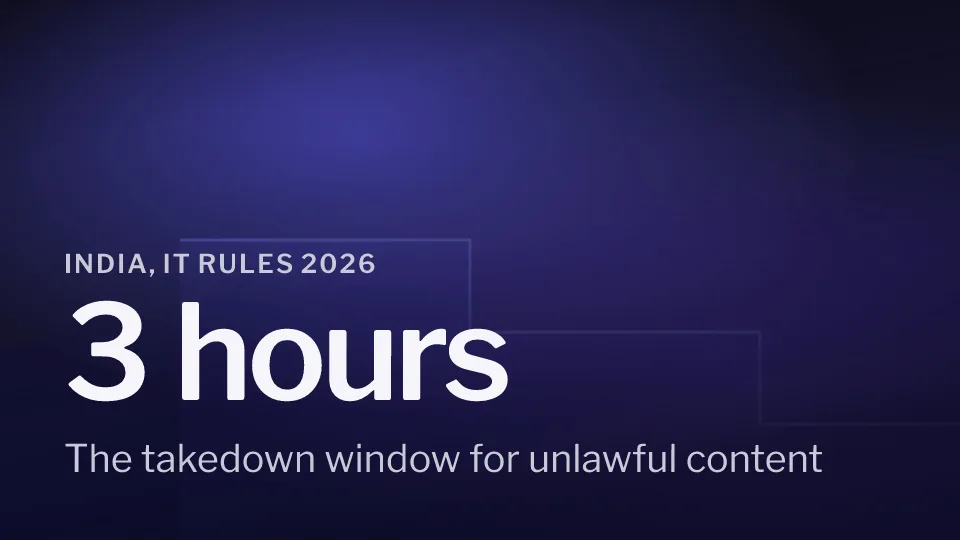
- Unlawful content now has to come down within three hours, and intimate deepfakes and impersonation within two. Using a real person's likeness is the fastest way to lose content.
On this page
Yes, an AI influencerAI influencer An AI influencer is an invented character whose photos, videos and captions are generated with AI instead of photographed. She is published, followed and monetised on the same platforms as a human creator. Read the full explanation is legal in India. No Indian law bans running a generated persona. In February 2026 the rules changed for synthetic media (AI-made content that looks real) after it is uploaded. Most of the new rules apply to the platforms. Only a few apply to you.
This article covers three things: what the changed rules say, which part applies to you as the person posting, and a draft rule that people still quote although it was dropped. It is a dated summary of published analysis of the rules. It is not legal advice.
What changed, and when
The Ministry of Electronics and Information Technology notified amendments to the Information Technology (Intermediary Guidelines and Digital Media Ethics Code) Rules on 10 February 2026, effective from 20 February 2026, bringing synthetically generated information into intermediaries’ due-diligence obligations.
Freshfields — India targets deepfakes and AI-generated content (IT Rules 2026) (opens in a new tab)checked
The rules took effect only ten days after they were announced. Because of that, a lot of what was shared in early 2026 still describes the draft and not the final text.
What counts as synthetic
Synthetically generated information is audio, visual or audio-visual content created or altered artificially or algorithmically using a computer resource so that it appears real, authentic or true and indistinguishable from a natural person or a real-world event. Text-only content, routine or good-faith editing, document preparation and accessibility improvements are excluded.
Khaitan & Co — MeitY notifies the IT Amendment Rules 2026 (opens in a new tab)checked
A photorealistic persona clearly falls under this definition, because it is made to look like a real person. An AI-written caption on its own does not. Ordinary retouching of a real photograph does not either. Instagram draws the same line for its AI-generated profile label. What matters is whether the person on screen is generated. How much software was used on the file does not matter.
What the platforms now have to do
All intermediaries must label non-prohibited synthetically generated information clearly and prominently, embed metadata or unique identifiers where technically feasible, and not allow labels to be removed. Significant social media intermediaries must additionally require users to declare whether uploaded content is synthetically generated and verify those declarations with technical measures, rather than relying on the user’s word alone.
Freshfields — India targets deepfakes and AI-generated content (IT Rules 2026) (opens in a new tab)checked
“Significant social media intermediaries” are the large platforms. In practice these are the platforms a persona is likely to post on. Take the verification part seriously. The platform has to check your answer against its own detection. To do that, it is likely to read the provenanceProvenance Provenance is the recorded history of how a piece of media was made and changed. Open the glossary data in your files: the hidden data that says a file is AI-made.
How do I handle the upload declaration on each platform? Ask it in #question-thread. Someone there has usually had the same problem.
What you have to do when you post
Do these three things.
-
Declare honestly at upload. When a platform asks whether your content is synthetic, the answer for a generated persona is yes. The platform is not allowed to simply trust your answer. A false “no” breaks the rule and is likely to be caught.
-
Expect the label and leave it on. Platforms now have to label, and they may not allow labels to be removed. A plan that needs unlabelled content in India will not work.
-
Keep the metadata intact. Platforms are told to embed identifiers where feasible and to check declarations with technical measures. For that they use provenance data, and a careless export step deletes exactly that data. Don’t strip your watermarks shows where pipelines lose it.
One rule is aimed directly at you as the person posting.
Users must not direct or cause a computer resource to create or publish synthetically generated information in contravention of applicable laws, or they face suspension of access and penalties under those laws.
Khaitan & Co — MeitY notifies the IT Amendment Rules 2026 (opens in a new tab)checked
The 10% label rule was dropped
The draft’s requirement that a watermark cover 10% of the content was dropped. Visual synthetic content must instead carry labels that are prominent, easily noticeable and adequately perceivable, and synthetic audio must carry a prominently prefixed audio disclosure.
Khaitan & Co — MeitY notifies the IT Amendment Rules 2026 (opens in a new tab)checked
You may have read that Indian law wants a label across a tenth of every image. That was the October 2025 draft. The final rules say the label has to be prominent. They do not set a size.
What the sources do not say
Using MeitY's own FAQ as the source for the final rules
The obvious main source for this article was the ministry’s own FAQ on the amendments. The FAQ document this site found on the MeitY website sits under an October 2025 upload path. That is the time of the draft consultation, and the draft contained the 10% label-size rule that the final rules dropped.
A document that may describe the draft cannot be cited as a description of the final rules without saying so. Nothing on the page showed which version it describes. For that reason every claim here comes from two law-firm analyses written after notification, Freshfields and Khaitan & Co. They agree with each other on every point used.
Unlawful content now has to come down within hours
The window for removing unlawful content fell from 36 hours to three hours, and for non-consensual intimate imagery and deepfakes from 24 hours to two hours.
Khaitan & Co — MeitY notifies the IT Amendment Rules 2026 (opens in a new tab)checked
For you this matters mostly in one case: a real person’s likeness. If your generated character looks like someone who exists, a complaint can take that content down within hours. Invent your persona’s face. Do not model it on a real person.
Your account will rarely reach only India. Are AI influencers legal compares these rules with the US, the EU and the UK. If your audience is mostly American, read do I have to disclose AI content in the US. If you have followers in Europe, work through EU compliance for AI personas.
Sources for this article
The platform rules, laws and numbers above come from these documents. The date says when we last opened each one and checked it.
Questions people ask
Are AI influencers legal in India?
Yes. The 2026 changes to the IT Rules do not ban AI-generated personas. Platforms have to label synthetically generated audio and visual content. The largest platforms also have to ask users whether an upload is synthetic.
What do I have to do as the person posting?
Answer truthfully when the platform asks at upload whether your content is synthetic. Do not use AI content in ways that break other laws. If you create or publish synthetic content that breaks a law, your access can be suspended and you can face penalties under that law.
Does the label have to cover 10% of the image?
No. That rule was in the October 2025 draft and was dropped. The final rules say a visual label has to be prominent, easily noticeable and adequately perceivable. They do not give a size percentage.
Does text generated by AI count?
No. The rules cover audio, visual and audio-visual content that appears real. Text-only content is excluded. So are routine good-faith edits and accessibility improvements.